Levitation and Fussbudget Literature: An Interview with Wayne Koestenbaum
Robert Keily
Robert Keily: I’m halfway through my second read, and this novel is an incredible achievement. You work in many forms: poetry, nonfiction… What does fiction afford you, what ‘s different about it?
Wayne Koestenbaum: When I was 18, a freshman in college, I announced to myself that I wanted to be a writer. At that point, my genre was fiction. I took a course in fiction writing instead of expository writing, and that fork in the road determined all the rest of my work. If I’d studied expository writing, my essays might be more linear and organized, but instead I chose fiction, the expressive route. I secretly wanted to be a poet, but I felt ill-equipped, daunted. I hadn’t read enough poetry.
When I was 22 I decided I’m a poet, no more fiction. The characteristics of poetic writing come more naturally to me—wordplay, sound, association, innuendo, connotation, metaphor, a certain rhetorical remove from circumstance. I’m less capable of normal storytelling. But I’ve always held the “novel” above me as a kind of aspirational Valhalla. Whenever I’ve written a nonfiction book, I tell myself, during the process of composition, “pretend it’s a novel.” A novel strikes me as a vast container for everything, for all of one’s imaginative resources and fantasies. A novel is an environment for me to live in as I write; a novel is a space for centripetal world-making. What was satisfying for me about writing My Lover, the Rabbi, was creating an obsessional world, centrifugally as well as centripetally.
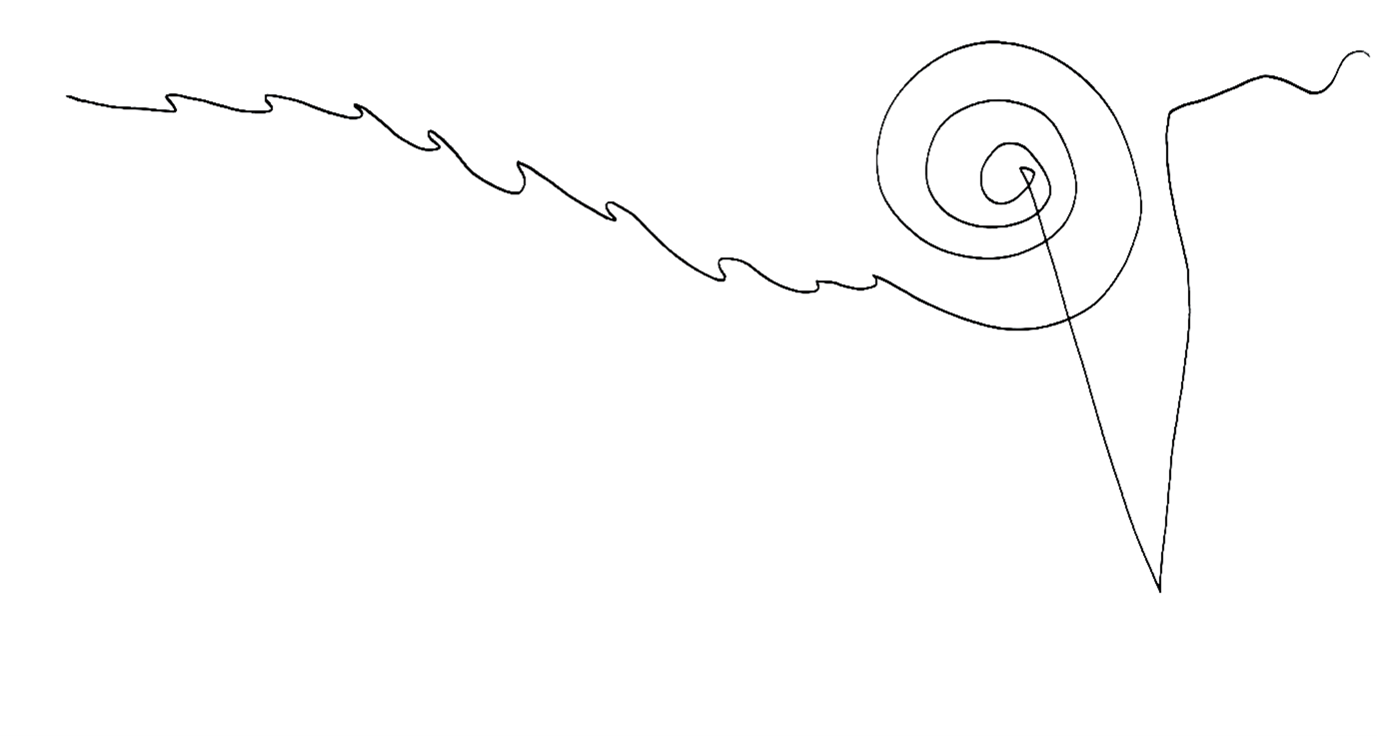
RK: Yes, that centripetal world building seems really important to the novel. I tried to draw the plot. I drew this:
The left is the start, and the spiral was that feeling of centripetal force. On first read, it started to swirl from halfway through. Before that it felt like one long ode to the rabbi. It felt like a poem. On second read, the centripetal force or swirling is there much earlier. What’s your general feeling about spoilers and plot? In one chapter the rabbi tends to “leak pre cum” and the narrator says that this is like constantly “giving away the plot too soon.”¹ I was wondering how you plotted this. It is really playfully messing with our expectations. There was a revelation, but then the revelation that an event in the book was a dream, was itself a dream. I had a moment of being infuriated with that toying!
WK: The entire novel was contained for me, and given away, from the very beginning. If the big mystery of the book concerns the rabbi’s first wife and child, we glean the information, or fragments of it, right away, but the full presentation of the facts is perpetually deferred. It’s as if I were not the novel’s author but its victim: I’m the one compelled to dream this book. The narrator, who is me but not me, is torn between a full knowledge of the entire plot, and a state of being absolutely in the dark about details. Revelations keep arriving, but the narrator remains confused, and on the hunt for further clarity—which has already been offered! The book conveys a sense of mysterious, suspenseful deferral of information, although most of the plot facts have been disclosed at the outset. In utero at the beginning is the whole story, and yet I remained willfully enchained by mystery as I wrote the book.
The obsessional energy of the syntax stems from the paradox of knowing and not knowing. I was influenced by Henry James, particularly his later books, like The Sacred Fount. Henry James sets up the possibility of a book in which there can exist a perpetual giddy state of not knowing. The first half of of my novel is more continental in its influences. And then the Henry James thing starts to happen.
RK: Yeah, some things that I had considered were revelations were always there and yet there was a gradual unveiling. In the same way that the “inverted” L’Origine du monde is present at the opening.² Everything has been revealed, and yet there’s loads of further exposure to do. It is a very fascinating structure.
WK: You will never know fully the story of your own life. There’s not a continuity of consciousness throughout life: consciousness or memory kicks in at a certain point, maybe age five, and then a general seamlessness (with major gaps) is established, but the first five years are darkness. The paradox is that you can know fully the circumstances of your life, while many details remain fruitfully a source of mystery.
RK: The book mentions loads of paintings, music, films, but I was particularly interested in books which offered as windows into the souls of some of the characters. Monica Prague is reading Robert’s Rules of Order, which is an incredibly perverse thing to do.³ Paul Goodman’s Growing Up Absurd is important to the rabbi’s sermons.4 Our narrator, the antique furniture repairman, was read Edith Wharton’s The House of Mirth in his early life.5 Later he seems got really into biographies and he has the two volume biography of Picasso by John Richardson.6 What other books are important to this narrative world?
WK: I love your list of them. In the novel, my references to those particular books came about accidentally, though obviously a series of over-determinations destined their appearance. Aspects of writing are, in a sense, magically predetermined but absolutely accidental. Paul Goodman’s Growing Up Absurd gets the most airtime. I’ve read Paul Goodman’s Growing Up Absurd, but I have no memory of its contents. A long time ago, in my early 20s, I bought a book of Paul Goodman’s short fiction published by Black Sparrow Press.7 And I love a poem of Goodman’s, his most famous poem: ‘The Lordly Hudson.’8 But I wonder if my choice of Paul Goodman has deeper roots. I love Susan Sontag’s elegiac essay about him.9 Right now I’m revising a new book of essays, which includes the sentence, “I dreamt that Susan Sontag assumed that I loved Paul Goodman.” The appearance of Paul Goodman’s Growing up Absurd in my novel is governed by a surrealist poetics of dream inevitability and an impossible-to-catalog series of associations, rather than a consciously crafted allusion.
RK: There’s also some that I forgot to list, which is a quick glance. I think, when the narrator is talking about Tamara Atkins, I can’t remember whose library it is, but the titles given are Principles in Depth Psychology and Advanced Sociological Problems.10 We can bunch those up with Paul Goodman’s sociological analysis of youth and delinquency and Robert’s Rules of Order, which is an engine for collective meaning-making and seems to invoke these organizations which the rabbi moves through, like the Friendship center. And there’s lots of love, complicated love, and connection. There’s a very beautiful moment where the narrator is almost in a motherly pose with Dito.11 But at the same time, the narrative, if not the narrator, is incredibly lonely. There’s something happening there between all those unconscious callbacks to wide-lens sociological perspectives, and the lonely meaning-making of the centripetalized narrator, with us stuck in his head.
WK: While you were mentioning facts of the book’s plot, I wondered, “How does Robert know those details?” I thought I was the only one who knew that stuff. This is the first conversation I’ve had with anyone where plot particulars get pointed out as if they were existing features of the landscape. And so I have this funny feeling of having been eavesdropped upon or having been mind-read. I’m cognitively flummoxed by the fact that these things are evidently outside me, because you’re not pointing to Dito in my head, you’re pointing to Dito in the book, and you’re the first person who’s ever said that name out loud to me. And so I feel a strange sense of ambush and of—I was going to say “denuding,” but that’s not accurate—a sense of discovery, in a judicial sense, the process in a trial. While writing this novel, I kept its plot shrouded in a mysterious fluid, my brain matter, and I did not externally map out the narrative particulars. I never divulged to an outside world the facts of the book, so that the coordinates could remain in flux. The plot could remain dreamt, subject to re-scripting and redetermination and renaming.
A different kind of fiction writer might have a more safely externalized sense of what the plot points are, rather than letting them carry on a secret existence as dream details. I wrote the novel by hand, so during the process of first-draft composition, I never had the option of rereading everything, or not easily. I drafted the book in bound notebooks, 30 or more of them. If I was, for example, in the midst of writing in notebook number 20, I didn’t necessarily have all the earlier notebooks nearby to consult. I was stranded in my own little island. I wrote each chapter in one sitting. I would reread the previous chapter, and then I would jot down a few notes of what I wanted to happen in this next chapter. These little interstitial notes got longer as the book proceeded. I had an increasingly complex notion of the narrative ground that I wanted to cover. I had to catch up with who the people were and what was going to happen next. But there wasn’t a huge space of deliberation before drafting each chapter—just the quick notes you might make before you take a long car trip through unknown terrain. My sense of navigation was always as if by night, as I was driving my way through the book.
RK: I don’t want to put words in your mouth, but I’m getting a sense that there’s almost an epistemic horror to that externalization of the plot, to it being seen. It’s like, oh, God, oh no.
WK: Exactly.
RK: Did that happen with Circus: Or, Moira Orfei in Aigues-Mortes or other fiction projects?
WK: I can’t remember now if I had the same sensation with Circus. It’s a similar book, very similar, but in Circus it’s a little clearer who the characters are. One of them is actually a historical figure, Moira Orfei. You could Google her and see a photograph. So even though that book is a product of fantasy and a highly unreliable first-person narrator, it’s a simpler landscape. The premise of Circus is that the novel is the very notebooks that the narrator is writing, and so, throughout, the narrator is aware that he is writing notebooks that someone might eventually read. The novel contains much meta-inscription of the fact that the narrator is keeping notebooks and that he is thinking of this internal exhumation as a writing project. In My Lover, the Rabbi, there’s one moment where I really spill the beans and I say, “should there be any reader of this in the future, the reader should know...”12 I don’t really follow through with that line of speculation. And it’s almost a mistake in the book that I let spill the narrator's knowledge that this text is something that he’s composing. In Circus, the narrator knows that he is creating a verbal artifact to be read eventually by somebody. In My Lover, the Rabbi, the textual status is murkier; the narrator is not aware that he is writing—he seems instead to be thinking, prognosticating, remembering, fantasizing. And somehow, magically, the reader can eavesdrop on the narrator’s cogitations.
RK: That bit that you deliberately left in, that feels like a kind of air vent, or escape duct in the narrative. There’s an amazing one in Beckett’s Mercier and Camier, there’s just one line in the book, which just says, “I was with them all the time.”13 And the “I” never re-appears… Now, a bit of a swerve, but, what would say to somebody who’s not got a sense of the book’s geography?
WK: It was very important to me that this not be a New York City novel. The contemporary novel that I read that had the most influence on me recently is Claire-Louise Bennett’s Pond.14 I love a work of fussbudget literature that takes place in a periphery, a vaguely rural, small-town outskirts. What’s important about the geography of her book (and mine) is that they take place in a murky, unmarked, unpopular zone away from the urban center, a zone where lives can have a certain smallness, but also where local matters of body temperature and appetite and irritation and small encounters can have a major impact on the mood of the day. In my novel, we occupy a culturally unmarked zone. It’s not the suburbs; it doesn’t pay obeisance to a city that’s nearby. In a sense, the most dangerous air vent in the book is when the trick Udi, from California, comes and stays in Ridgewood, a New York City borough that is gradually becoming gentrified. And so when the narrator gives Udi directions on how to take the PATH train to Hoboken, that admission was a dangerous air vent. I was letting in too much reality. I was revealing that Hoboken is just a quick train ride from New York City, and that the narrator has more options than he admits. And I often had a sense of uneasiness when, while proofreading the book, I’d rediscover the line about Ridgewood, and I’d think, “Oh, I really shouldn’t be mentioning Ridgewood. It’s too real.” While revising the novel I also had a certain regret that I hadn’t taken a trip to Hoboken for research to figure out if Hoboken has an outskirts. I talk about a hill near Hoboken. Is there a hill near Hoboken? I don't know. I don’t think there is a hill anywhere near Hoboken; nor are there restaurants on the outskirts of Hoboken. The narrator’s abode on that periphery is a fantasy space, very much akin to the Pond space.
RK: Does the narrator drive? I think he doesn’t drive, right?
WK: I blow it. He does drive because he says, Udi should take the PATH train to Hoboken, and the narrator will meet him there. He says he’s going to pick Udi up. I suppose could meet him there without a car. But I think the narrator has a car because he goes on a pilgrimage to Woodstock. Atlas gave him that car. I think it’s a Honda.
RK: At least Atlas is this amazing get-out card for anything that could consider conceivably be a plot hole.
WK: He’s like an air vent deus ex machina.
RK: Exactly, fiscally.
WK: The novel has to levitate a certain amount of funds, yes…that’s very Jane Austen of me, or very early British novel of me, to foreground fiscal questions, in a very old-fashioned, classic way.
RK: I like that it was acknowledged that there was a reason why a certain space for obsessions was opened up, in an almost utopian sense.
WK: They all have fellowships from Atlas.
RK: That’s it. “Leisure class sugar daddy.”15
WK: Any queer utopia needs a sugar daddy.
RK: We were talking about facts there. I want to come away from the facts and get out to vibe again. The book has something like a levitational effect in the prose. I wondered if it is in the modal verbs, like “would”s, or all the questions. Even if I can’t find grammatically where it’s being done, there’s this sense of floating in between figure and ground, or murkiness. There’s a facticity to the plot, which is out there. But also what we’re getting is these impressions, like floaters in our vision.
WK: I write in a levitational way. It’s a survival strategy. How I get a sentence written, is by performing levitation. That’s probably why I haven’t written more fiction. I prefer a levitational mode of writing, a style difficult to achieve in fiction, which requires naming occurrences with a necessary credibility. In fiction, you’re supposing things, but you’re not letting the reader know that these events are merely imagined. I have always had a problem of or just a lack of interest in grounding the things said in such a way that you don’t have to cloak them in the suppositional. Even in my nonfiction writing too, I prefer levitation.
One of my favorite novels of all time is Jane Bowles’ Two Serious Ladies, a cult classic among New York School poets.16 Even though it takes place at first in New York City, it involves pilgrimages or devolutions via public transportation to outskirts of Long Island, where levitation is possible. Levitation in Bowles’s novel has to do with taking the train out to Long Island. Long Island is a space like the outskirts of Hoboken, a place where you can lose your identity. In reality, I’m not sure you can lose your identity in Long Island or in Hoboken. But as far as Jane Bowles in 1943 is concerned, Long Island remains as murky as a part of Ireland that I’ve never visited.
RK: You mentioned naming, wanting to resist it. The rabbi says he wanted his encounter with “the Syrian man” to occur “outside of every restriction and bloodletting that comes with the articulation of a proper name,” which is a really resonant phrase.17 I wondered about that, what you just said, and also the fun of naming. I’m thinking of Atlas Comstock Fitzgerald and the extended universe of the microfilms, where the names seem comic.
WK: There’s a big gulf for me in my fiction writing between the space where a character gets named, which is always, for me, a comic space or joke space, and the other space of fiction writing, of emotions and inwardness and fantasy, which is a non-comic space. A difficulty I’ve had in fiction is navigating the space between the comic, preposterous scene of naming, and the more serious narration of inward, experienced life. And in this novel, once a character is named, that character becomes flattened and mortal. The unnamed characters retain the capacity to be infinite and metamorphic. Atlas is the most locatable character; to him, I gave a comic name. There are aspects of comedy in the other names, but the scene of naming for Atlas is in a different tonal register than much of the novel. That tonal zone is the space that Laura Riding in Progress of Stories makes her own. Let me go get it for a second…
RK: Oh, yes, please do.
WK: Okay, okay. As the book progresses, she enters this space where to name a character is to flatten the story. For example, in ‘Daisy and Venison,’18 the first sentence is:
Daisy was a consciously happy young woman without any of the usual endowments that make for conscious happiness.
Next paragraph is:
Venison was the daughter of the once richest family in that town.
And then it gets worse. The book goes off the deep end. Another story is called ‘Reality as Port Huntlady’, and this sentence on page 85 is:
Dan the dog came to the town of Port Huntlady with to friends, Baby and Slick.
We started the book in a normal way, and by the time we’re at ‘Reality as Port Huntlady,’ the name announces the absurdity and the levitational aspect of the verisimilitude. That’s my tendency, too. Names are funny to me. So the choice to leave the main two characters unnamed in My Lover, the Rabbi preserved for me the possibility of poetry. Unconsciously.
RK: At the end of the book, the narrative drops the levitation act and becomes heavy, a heavy cube that hits your hands. It’s really impactful. It gave me goosebumps.
WK: I’ve always dreamt of a novel as a utopian space wherein there can be a concrete actualization and literalization of fantasy life in a compact, holdable, conveyable, transmittable form. That dream is announced as a death wish at the end of my book: the narrator has concretized his heartless heart into a cube. The process of the book means that this cube is now presentable and capable of being delivered to a reader. And the consequence of that metamorphosis is evisceration, disembowelment, and heartlessness. The heart could pretend it was a heart when it was inside, but once delivered, the heart is revealed to be heartless.
There must be a word for this state where the atomic universe centrifugally spins around its nucleus – the motion of that spinning is, in fact, what makes up identity. The nucleus, in the center of the spinning, is not a separate creature. It’s the spinning that constitutes the creature. With a poem, at least with a lyric or a short poem, it’s possible to see at once the spinning and the concretization of the whole. But in a novel or a long book, it’s not possible, except at those moments where you can escape the prison of the book and look at it from the outside as an object. But it’s true that with long poems, book-length poems, the poem can contemplate its all-overness, its cosmological ambition. Like Paradise Lost, to take a grand example, or Pound’s Cantos, to take a sordid example. Both poems are aware of their ambitions, aware of their spinning, aware of their wish to be cosmologically stable, despite the vertiginous swirl.
That was always procedurally clear to me as I was writing the book, because the process (for me, and maybe for any writer) is a state of extreme agitation and instability, a longing for stasis. But stasis can only be achieved by finishing the book. By choosing mostly to be an essayist and a poet, I’ve limited that state of agitation to a few days at a time.
RK: The book can have an air vent, but it can’t have an outside. The book doesn’t have an outside, but you as writer are now outside it.
WK: When I finished the first draft of this book, I immediately started writing another novel. And so while I was typing up the notebooks of My Lover, the Rabbi, I was not revising them until I had finished drafting a second novel. I didn’t want to face externalization. I wanted immediately to escape back into a novel, to escape into a region that was the exact opposite of My Lover, the Rabbi. I decided no more phallus. I wrote a novel about a woman. A trans woman. I wanted to leave the rabbi’s universe, and to retreat into another instability.
And then, when that second novel was done, then I started revising the Rabbi. The process of revision was very micro. I became obsessed with diction, and went deeper into a method of diction-revising that is essential for poetry, but that maybe I don’t perform as obsessively for prose. Or maybe I do? I searched in the novel for times I’d used a certain word. I had all sorts of rules about how many times I was allowed to use a word, and I cultivated a robustness of synonym. I was trying to retain a fastidiousness of poetic micro-control over the book, to let it keep its status as a levitated thing.
RK: That synonym thing. At one point the book says something about the rabbi and fire, and the next bit is something like “to flame I myself was constitutionally averse,” and it was funny to me that the narrative felt the need to synonymize fire to flame.20 Other words you can’t do that—there’s the “minaret,” which keeps coming back.21 Tower wouldn’t do it, right? I think of this as a courtly novel, Atlas Fitzgerald’s court, with a focus on two members. Courtly language is very ornate, indirect, and it has all these flourishes. I was wondering about synonyms, words we can’t rephrase, and courtly language.
WK: A poem always contains a Petrarchan core. My Lover, the Rabbi is clearly a Petrarchan book: I’m burning, but I’m freezing.22 That’s quite literally what happens at the end of the novel. And I was always obsessed with this Thomas Wyatt poem that’s given credit for being the first English sonnet, ‘Whoso list to hunt.’23 So my novel borrows the lyric DNA of a Petrarchan tradition of lyric poetry that travels through Shakespeare’s sonnets and then through to Dickinson and to O’Hara—a tradition of apostrophe, a voice thrown to an inaccessible other as an offering. This hailing procedure connects to the tradition of the poetry of courtly love. I’ve been very influenced, who hasn’t been, by the Pillow Book of Sei Shōnagon and that sort of court thinking.24 What it’s like being on the outskirts of a court, the kind of fussbudget thinking that you get mired in. The space of being a fussbudget is key to my writerly space, the realm that I conjure in all of my prose and poetry. Everything about this novel is fussy. The narrator is cranky. Everything is about minute degrees of pleasure and unpleasure.
————————————————————————————
¹ Wayne Koestenbaum, My Lover, the Rabbi (New York: Farrar, Straus and Giroux, 2026), pp. 55-6.
² Gustave Courbet, The Origin of the World (L’Origine du monde) (1866), Musée d’Orsay, Paris, which is mentioned in Koestenbaum, My Lover, the Rabbi, p. 1.
³ Koestenbaum, My Lover, the Rabbi, p. 390.
^4 Koestenbaum, My Lover, the Rabbi, p. 139.
^5 Koestenbaum, My Lover, the Rabbi, p. 15.
^6 Koestenbaum, My Lover, the Rabbi, p. 81.
^7 Perhaps this is Paul Goodman, The Break-Up of Our Camp: Stories, 1932–1935 (Santa Barbara, CA: Black Sparrow Press, 1978)?
^8 Paul Goodman, The Lordly Hudson: Collected Poems (New York: Macmillan, 1962).
^9 See Susan Sontag, ‘Afterword,’ in Paul Goodman, Growing Up Absurd: Problems of Youth in the Organized Society (New York: New York Review Books, 2012).
^10 Koestenbaum, My Lover, the Rabbi, p. 278.
^11 Koestenbaum, My Lover, the Rabbi, p. 226.
^12 Koestenbaum, My Lover, the Rabbi, p. 77.
^13 Samuel Beckett, Mercier and Camier, ed. Sean Kennedy (London: Faber, 2010), p. 3.
^14 Claire-Louise Bennett, Pond (London: Fitzcarraldo Editions, 2015).
^15 Koestenbaum, My Lover, the Rabbi, p. 102.
^16 Jane Bowles, Two Serious Ladies, int. Naoise Dolan (London: Orion Publishing Co, 2022).
^17 Koestenbaum, My Lover, the Rabbi, p. 148.
^18 Laura (Riding) Jackson, Progress of Stories (New York: Persea Books, 1994).
^19 Laura (Riding) Jackson, Progress of Stories (New York: Persea Books, 1994), 0p. 85.
^20 Koestenbaum, My Lover, the Rabbi, p. 117.
^21 Koestenbaum, My Lover, the Rabbi, p. 127, p. 130, p. 135.
^22 Petrarch’s sonnet 134.
^23 Thomas Wyatt, ‘Whoso List to Hunt, I Know where is an Hind.’
^24 Sei Shōnagon, The Pillow Book, trans. Meredith McKinney (London: Penguin, 2006).