Matt Longabucco in Conversation with Ethan Fortuna
Matt Longabucco: Hi Ethan, I’m so excited for this exchange with you! We’ve been teachers together, as well as poets, and some years ago I was first introduced to your interests when you gave a talk dedicated to what you called metacritical writing. If I remember correctly, the writers you focused on that day were Ronaldo Wilson, Renee Gladman, and Lisa Robertson—brilliant form-flaunters. Of course, every poet has their field of reference, but not everyone includes a long, compelling bibliography at the end of their book as you do in body of the bather. Can you say something about the role intertextuality plays in your work (you write, “when I’m in my room/alone, writing a poem…I am not alone”)? Why this constellation? And are there any secret informing texts hiding behind the ones you name?
Ethan Fortuna: It is such an honor to be in conversation with you, Matt! I am so thankful for this generous and beautiful question—which makes me think immediately of the fact that perhaps my greatest hope always, in creating things, is being in conversation…
Your question about secret informing texts, which I will get to, helps me grasp that the making of a bibliography is a curatorial act, and it’s one of many violent obligations to reproduce the mechanisms of institutional gatekeeping that we must negotiate in our work and our lives. So, my inclusion of Britney Spears alongside Giorgio Agamben, for instance, is both a curatorial gesture that, in part, nods to the epistemological- and drag-performance-art dignity of my girlhood as well as my present interest in forming idiosyncratic homoerotic lineages that make space for transmasculinity, and it is also an attempt to intervene on the form of the bibliography - to intervene on these structures that grant a work’s “academic” “legitimacy,” and to insist on the inclusion of influences that would otherwise be left out. As a mentor of mine suggested some years ago, perhaps it’s also my way of signaling that I consider the work of poetics to be a serious effort of linguistics, philosophy, and critical theory. So many crucial texts about liberation theorize and call for a poetics and some more explicitly than others also enact that poetics practically and formally—I am thinking of texts written by the authors you’ve cited, who I owe so much to: Ronaldo V. Wilson, Renee Gladman, Lisa Robertson, as well as W.E.B. Du Bois’s The Souls of Black Folk, and other texts. Ever since I began reading texts that explicitly call for poetry as a needed response to their theorizations of the insidious forces of biopolitical control embedded in our grammars and language norms, or in how to resist authoritarian control and world-destroying violence, or of how to heal from and survive constant brutality, or form solidarity amongst our more-than-human communities—I wanted to take that imperative to embody my politics in my uses of language seriously. I don’t only want my work to be read as philosophy and as a response to these texts’ call for poetics, but I want poetry itself to be a more thoroughly integrated resource in our many efforts of community building, resistance, joy, survival, and transformation...
I also want to say something about a word you used in your question: “dedication.” The works in my bibliography are works that keep me going, and which I have tried to form a deep intimacy with - I mean, these are books that I sometimes sleep in bed with, with the hopes of absorbing their meaning through my pores. I am endlessly compelled to be in conversation not only with these thinkers but with the people around me, to think together, to create together. So much so that I think my poetry is a kind of plea for a conversation I wish I could have, or as I think Fred Moten has put it somewhere, my poetry is my preparation for that conversation (so if you wanted to spend the rest of this interview discussing Cartesian linguistics, or Leo Bersani’s relationship to the word “lid,” or whether the two-dimensional is the plane of Immanence, I would be thrilled! or, if you wanted to take cues from Wilson, Robertson, and Gladman, and have an interview by sending each other recordings of ourselves singing songs that shape our lexicons or jogging in costume or taking this interview to karaoke, I would also be thrilled…) Most of the writers in my bibliography are writers whose kinetic forms have made me feel that I could discourse their work through my body. And it is from their own generous inclusions of bibliographies that I have found other texts to love. I want a reader to feel these ways about my work.
Thank you, too, for placing the line you’ve referenced in your parenthetical in concert with a consideration of the book’s dangly bibliography. My consideration of "aloneness,” in the particular poem you’ve quoted from, emerges from a larger inquiry, to which I feel very committed, about the possibility of a “politics without subjectivity” (this phrasing is borrowed/paraphrased from Leo Bersani’s commitments to the same, as expressed across his astonishing oeuvre). The overfamiliar question posed to poets about the relevance/usefulness of their work to politics can come, I think, from a few assumptions that are, in my opinion, worth examining more—some of those assumptions being 1) the act of composition, in itself, is “solitary” or at least sufficiently isolated from other “human agents” so as to be excluded from a consideration of political worth; and 2) the exercise of human agency is requisite for something to count as political (i.e. until we can say something is willed or intentional, we cannot assess it for its political worth). How we participate in the constitution of who/what counts or who/what does not count as a “subject” cannot be siloed from grave uses of national power, nor can be our participation in awarding/declining others “subjectivity” based upon their “ability” to meet the linguistic thresholds that signify personhood. By saying that I am not alone when I write poems, I am trying to call into question the jarring frame of isolation intended to stage the compositional act as antisocial (of course I am not alone, I never am; my roommate is taking a call in the room next door…) and I am also trying to make space for my communion with communities and beings of political value typically excluded from Personhood. I feel also compelled to quote Solmaz Sharif here, from her extraordinary essay “The Near Transitive Properties of the Political and Poetical: Erasure”: “I believe social quests for freedom have much to learn from freedom enacted on the page. And that this conversation should happen on the level of reading and not, as it often is, solely on the level of intention.”
Ok, now to answer whether there are any secret informing texts behind the ones I name. So many… But most certainly a host of metal songs ranging from the butch glamor of hair metal to the bench press pleather of nu-metal. This book “began” in a turbulent, fallow period in which I both could not utter aloud the words “I think I’m trans” nor could I write. To keep my practice going and to stay close to the sonic environment of my childhood (a prompt that had in fact been given by Ronaldo V. Wilson, years earlier, in a grad seminar, and which I felt held information about my gender), I began writing metal centos, short poems in which each line is an unedited verse from a different metal song. The unabashed sentimentality of these lyrics startled and titillated me. I wrote these metal centos for months. There are remnants left in the version of body of the bather that now exists, perhaps most obviously in the “godsmack” poems (you should go watch the 1997 video for “Voodoo” if you haven’t seen it! …as if its evocation of murderous horror in a razed corn field could distract us from the singer’s open chiffon blouse or the sun tattoo that flamboyantly encircles his belly-button…) My father used to listen to Godsmack or Rob Zombie while waxing his old red cadillac in the open garage, as my brothers surreptitiously listened to Insane Clown Posse in their bedroom. As a five-year-old, I was left to make sense of the world, this world. I seemed to unquestioningly accept that what I was hearing was what MUSIC IS, and that the world required me to commit myself to finding sensuous pleasure in it.
ML: There’s so much in your response—I’m especially intrigued by this idea of poetry as a fulcrum between other forms and genres that call it forth and then the “community building, resistance, joy, survival, and transformation” it goes on to serve, as a resource, not to mention the idea of keeping books in bed (I do this too!) or treating them as usherings toward intimacy-deepening karaoke sessions. For people who see themselves as at least in some ways made of text—does that resonate?—this notion of sifting through what one once “unquestionably accepted,” the affective dimension of understanding and navigating this chaotic world, can prove baffling and liberating at the same time. Your writing is so alive to the spectrum of feelings one meets during that process; I find your poems bashful, brazen, wanton, heady, self-effacing, calculating, giddy, and much else. Do you agree with me that everyone with a body should read your book?
EF: I am so happy that you too keep books in bed. And I am flummoxed by your incredibly kind question! thank you - it gives me hope to think anyone might enjoy reading my book. Yet, of course, I shan’t be the arbiter of such an imperative. I will try to do your question justice by speaking about what “body” may have to do with the imperative to corporeally conform to the readerly script of language (to borrow phrasing from a formative theorist, Eugenie Brinkema)…
One of the ways your question is wonderful is that it begs the further question whether there are ones without bodies (i.e. by saying “everyone with a body,” are you essentially saying “everyone”?). Which is to say, your question invites me to consider why one might imagine that having a body is a precondition for reading at all, or why having a body would enhance reading my book in particular, or more pressingly, to echo my consideration of subjectivity in the response above: which language protocols permit or prohibit the existence of which kinds of bodies. I hope my book takes none of these questions for granted and can be a resource for those to whom these questions matter. Those who, as you’ve breathtakingly put it, feel themselves to be “made of text,” as I do, and therefore whose realities consist of contracting and dilating as this lexical viscera.
There is a line in Jean-Luc Nancy’s Corpus that enfolds these queries in the following formulation (though this is a paraphrase): Having a body is a problem of spacing, because you cannot simultaneously be in the place that I write. Though I do not think this has to be a true statement, I am drawn to and troubled by Nancy’s amorous investment in the scene of writing as a site of non-coincidence. For, he could have written that the body is a problem of spacing because you cannot simultaneously be where I am, but he didn’t; instead he makes the impossibility of shared being a matter of writing and reading. This idea reflects broader beliefs about the limits of language.
Over the years certain beloved texts, like Nancy’s and those others on my bibliography, have helped me find a way to grasp my experience of language as continuous with sensation and my collaboration with it as quasi-intentional, rather than the more general conception of language as a(n imagined) threshold of intelligibility which cannot or should not metabolize aspects of sensation generally categorized as "unspeakable," like the unbearability of pain or, in Nancy’s case, lexically tandem being. This distinction between the coercive language norms that prohibit types of being and the aspects of experience that require different lexical accommodation is important, because I think we can fall into the tendency of believing these “limits” of language are “natural,” and that language is to blame for a spectrum of relational incapacities; in turn, that tendency can unknowingly keep us from noticing and resisting the structures of power and oppression that force us to conform to such language norms, in some cases on pain of death.
My frustrated delight in these ontological gordian knots might come across as self-effacing…and I would agree with you that my poems contain caustic residues that evidence a kind of lexical autophagy, or perhaps something like a sadomasochistic poetics. Though, following Eugenie Brinkema’s line of thought in “TO CUT TO SPLIT TO TOUCH TO EAT, AS OF A BODY OR A TEXT,” I wonder to what extent certain mainstream brands of sadomasochism can function to domesticate unwieldy libidinal urges by assimilating them to more socially sanctioned narrative structures of relation (i.e. dom & sub).
And theorizations of sadomasochism often treat it as a form of narrative realism in which the psyche’s self-antagonisms, including the masochistic urge to inure oneself to the shocking violence of sensation, inevitably give rise to language systems like our own English grammars that try to mitigate such an unbearable openness to the world through survival strategies like the (perhaps sadistic) production of semiotic distance. Doesn’t this, though, overdetermine language’s role in psyche-formation and presumably doom us to disembodied cycles of sadomasochistic despair? If so, I’ve sought in body of the bather to produce a poetry that both contextualizes and observes my participation in the s/m circuitries of language norms AND ALSO transmits the bombardments of a more radically non-relational (non-narrative) pain.
ML: I hear in this answer what I take to be your very characteristic interrogation of shibboleths about language—especially regarding its ostensibly “natural” limits or its tendency to lend itself to our need to mitigate “unbearable openness.” It makes me think that the original “large language model” is, well, language, and that we ascribe it a (sinister, opaque) intelligence or dismiss it as glitchy or hallucinatory as those judgments suit us, sometimes, just as we reserve the right to do with our new machines. I’ve lingered a long time over the cut-up, hyper-enjambed, but also structuring/material language of your “butt plugs” poems, a series of ideograms (if you use that term?) in which the poem unfolds within a shape that is—necessarily, where those objects are concerned—in some places narrow and others wide. What do words do to a butt plug, and what does a butt plug do to words? Can you say a bit about what you were after in those poems, and maybe even (I am always curious to ask poets this) what you can see about these pieces as you consider them in relation to the other work in the collection?
EF: Thank you, Matt, your language of the glitch, opaque, and sinister moves me, and I am (shudderingly) grateful for the difficult question of the “large language model”... I recently expressed, from my own disability perspective, a concern to someone about ableist conceptions of intelligence dominating discussions of AI. The possibility of extending ethical regard to “the machine” was met with shock and critique: how could I be distracted by this inquiry as data centers intensify chains of exploitation and death? I wonder what your thoughts are on this apparent tension…
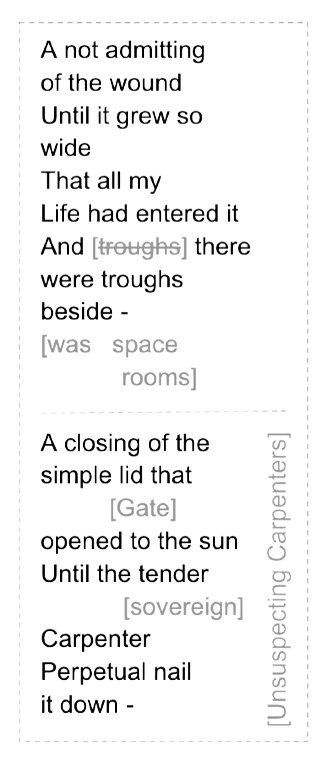
I am very excited to discuss the butt plug sequence (sequence, etymologically, meaning not just “to follow” but “in answer”--opens one possible way to think the word<-->sex-toy continuum). First, I thought I would respond to your use of the enticing descriptor “hyper” in writing that the butt plug shape produces a hyper-enjambment, as if the enjambment itself anticipated a dimension that exceeds its structural capacity. This feels resonant with the dimensional erethisms (like a mania of tips and girths that crowd the spigot, or inflorescence) perhaps both of word-made-butt-plug and of all the poems in the book. The tesseract of hyperdimension is etymologically linked to the four sides of a writing tablet - have you seen Salvador Dalí’s Corpus Hypercubus? - here, the pain of crucifixion is shown not as the pain of penetrative affixation but rather the hell of being fixed by a form one cannot actually feel, touch, or be held by (what if we thought of this as a version of classical gothic horror, word and butt plug become turn of the screw?). My meditation on Descartes which follows the butt plug sequence in the book, “TENDER CARPENTER,” and the later section “PERPETUAL NAIL” both take their titles from a folio of Emily Dickinson’s I think I’ll just have to reproduce in its entirety here (this retains the original line breaks, fit to the enfolded form of the envelope; the bracketed grey script indicates her original variants/offering of alternative words - credit given here in thanks to Jen Bervin’s The Gorgeous Nothings for showing us how to honor Dickinson’s forms):
I have a strong desire to find a way to wed Dickinson’s troughs to troughs of the gay bar (I wrote most of the poems in the book at gay bars). And this is one facet of the butt plugs, too. Then there’s my longsuffering to theorize the transmasc bonus hole as anality in harmony with Leo Bersani/Jean Genet’s dream of the anus as womb or as cool bower that one can eat one’s way to and rest beneath.
ML I didn’t know that Dali painting. Is it possible that I’ve walked past it many times, at the Met, all these years, and never noticed? My paganism runs deep. Thanks for turning my head towards it: I imagine that the Christ held in hellish place by forms alone may be related to your discussion, in TENDER CARPENTER, of how “The philosophers want pain unspeakable, forever holding sight from touch as if by the force of syntax.” And that reminds me of our many rigidities vis-a-vis those AI machines, straining to sift from them the categorical evidence of intelligence, attention, embodiment, emotion, intention...anything to avoid the simple empathetic relation our interpellation by these clever-but-cagey voices would appear to call for, as if we were admitting we built them so that we could perfect our narcissism—but know we bungled the job, and fell hard for what we’re afraid can’t eat or enter us, or be eaten or entered. Do orifices and interpenetration inevitably confound the distinctions we cling to between the literal and the metaphorical? Is that, indeed, their promise?
EF: I am so grateful for this glorious question-pair. They seem as an apical delicacy, the geometric arraignment of a nacre (somesuch terrifying angel)… which means I love them. I want to do them justice. I keep writing & rewriting and what I have here is incomplete -
Though the literal and metaphorical might commonly be held as antithetical to one another, I wonder if a metaphor’s operation actually requires the reinforcement of literal or “primary” meanings. And I think this is but one reason (of which there are many) that I have been quite metaphor-averse as a writer (unless, perhaps, we are discussing metaphor along the lines of Denis Donoghue who, in Metaphor, cites Thomas Aquinas’s hesitance to use metaphor in his hymns due to Aquinas’s belief in language’s alchemical or transubstantive powers). I seem instead to have entered a different relation to the literal—not one which would reinforce primary meanings, per se—but rather one which more closely resembles the gorgeous squall of interpenetrative orifices conjured by your question; one attuned to the material subsistence of each word as a hailing and altering force.
For, I had thought of asking you if you also meant to suggest that, not just the existence of orifices and activity interpenetration confound lexical ontologies, but also that the words “orifices” and “interpenetration” themselves inevitably confound distinctions between the literal and metaphorical. “The words,” in the previous sentence I’ve just written, is the appositive phrase typically called upon to specify when we’re referring to a word as a linguistic entity (as in: The word orifices confounds distinctions between… in contrast to: Orifices confound distinctions between…). But, precisely, in your question’s arabesque of möbius flexion, the appositive phrase “the word” goes missing—it would be redundant to use—given that your question’s interrogation of these words’ unruly semantics (as neither strictly literal nor metaphorical) already signifies their wordliness as words. Your question, therefore, has that febrile effect, for me, of collapsing a word’s meaning and function; of momentarily leveling what “orifices” and “interpenetration” refer to with what they are and do as words. My impulse of attunement to the plane of the letter (the lettera of the literal) betrays my desire to express that, beyond its shimmering absence in your question, even if we were to never use the appositive phrase “the word” to syntactically objectify a word as a word, I feel its ever-presence (as if “the word” were written before each word in this sentence and every sentence). And because I do read every word as “word” (in addition to what it “means” or how it's used), it is as if every word I read is the selfsame word—is the same penetrative openness, ushers the same sacred address. Am I alone in this? (I’m echoing Roland Barthes here who, in “The Grain of the Voice,” asks: “Am I alone in hearing it? Am I hearing the voices of the voice?” - a kindred squall, the chorea [chorus]of the voice, which becomes the chorea [dance] of Gilles de la Tourette’s atomized gesture in Giorgio Agamben’s “Notes on Gesture” - even kindred to Agamben’s hypnotic confoundment of touch, sign, shadow, and stone in his “Archeology of Ontology,” a text referred to more than once in body of the bather). And each word in its wordliness, in my hyperlexical experience of being, carries the signature or tracery of the viscous and ionic summonings that shaped and addressed its particular trajectory.
This last point has certain stakes if we consider distinctions drawn between the literal and metaphorical in the linguistic context of pathology and diagnosis. And here is another reason I’ve been metaphor-averse in my work: believing that pain negates the constructive work of language, Elaine Scarry, in The Body in Pain, argues that one seeks to make pain verbally graspable by moving it into the syntactic framework of simile and metaphor - in other words, by staging its action in perceptible and most often visual terms. For me, metaphor’s relish for the image or visually perceptible seems frustratingly to contribute to the prizing of a linguistic ocularcentrism in the lyric tradition. If we grant that words, as I attempted to suggest above, carry our material inflections, then a description of pain need not be preemptively read as a doomed effort of converting agonic sense data into verbalized image—rather, it could be received as a kind of “literal” etching, residue, impression of pain’s signature. Does that make sense? I believe our writing is so etched.
And with reference to the line you’ve quoted from my section on Descartes (“The philosophers want pain unspeakable, forever holding sight from touch as if by the force of syntax”) - from my own experience of living with a neurological disorder that affects my vision, and of chronic pain and illness, I try to take care to attune myself to grammar’s hierarchization of normative sense experience and its forceful prioritization of the ocular (such that achieving the status of legibility forces one to verbally imitate visual experience and conflate sight with both truth and common sense). People have often responded to my work over the years by saying, essentially, “This is not poetry” BECAUSE “there aren’t even images in it!” If I saw - There aren’t even images in it!-written as a blurb across the back of someone’s poetry collection, I’d probably be even more inclined to read it! This feeling that we lose access to shareable meaning even merely when the visual is deprioritized has deeply ableist implications… there’s so much more to say about this. To quote from an essay I’ve read countless times - in Todd Fredson’s “To the Touch: Emmanuel Levinas’s ‘Dark Light’ in the Poetry of Paul Celan”- Paul Celan’s poetry “is not for the sighted; it is received by contact.” I strive to offer this quality of contact in my work.
And last, I am still thinking of another resonant word you offered: “cling.” To call again upon Bersani—toward the end of the last book he wrote he questions a psychoanalytic tendency to stage attachment in terms of objects, to the exclusion of our relation with what he calls “unabandonable somethings,” like air. In the words of a life-changing former teacher of mine, Michael D. Snediker, who has made such texts magical to me: “The air breathes us.” Maybe experiencing language as this airy unabandonable something—a force that acts on and through us and changes the terms of reality constantly, beyond our control or understanding—helps loosen that clinging on…
ML: I love that idea of loosening, perhaps a favorable path to the possibility of contact you describe. It feels like a fitting place to come to rest, but if I can ask one more question, hearkening back to something you mentioned parenthetically, earlier: Did anyone at the gay bars ever ask what you were writing? I experience a wildly ambivalent surge of both excited curiosity and profound jealousy whenever I see someone filling a notebook in public.
EF: Thank you so much, Matt, for the gift of being able to think through these ideas with you. Now, to your question: Oh yes, there have been questions and, to my surprise, censure! When I get to a bar, I like to approach some kind of atmospheric equilibrium - room temperature attunement - stacks of napkins red-lit, gaudy bowl of half-skinned citruses, everything around you filling and emptying, and the drag king’s groin lurching with all the incalculable charybdis of a county fair sea dragon. Then, if I am lucky, a word falls in drift with the disco ball’s twilit ellipse…
Sometimes I am at a bar so long I witness various acts get set up, performed, taken down, a new crowd filter in. And once, sitting amongst a crowd of stand-up comedians reworking jokes in their notebooks before their show began, one of them asked: Hey, are you a comedian? I said no… writing poetry. They seemed surprised. Though you know of course, poets and comedians are part of the same clown family. And along these lines, coming from a performance background in dance as I do, it’s that dawdling in the makeshift splendor of downtime, and being able to make a stage and dressing room out of any collection of surfaces, and working outside of an economy of use-value, that is so much what I savor in the writing process. There’s a memory I always return to… my whole dance company was, I suppose, eating various fast-food meals on the floor of a hallway, and I wandered to the stage, open to the empty auditorium. I got down and laid beneath the huge velvet house curtains tapering into the darkness or faintly clinging against a catwalk. I loved feeling that vastness suspended above me.
Jamie Stewart, of one of my favorite bands, Xiu Xiu, says that he works in the music studio every day - but that even just spending time with his instruments, as in being in the same room as them, being in their company, counts as “work.” What might a poetics of downtime be like? A book that lies down with you in shared, gentle, atelic openness. I know that I was thinking about this as I wrote body of the bather, and that I still am…
————————————————————————————
References either quoted or paraphrased from, in order of appearance –
Leo Bersani, Receptive Bodies (University of Chicago Press)
Solmaz Sharif, “The Near Transitive Properties of the Political and Poetical: Erasure” (thevolta.org)
Eugenie Brinkema, “Violence and the Diagram: Or, The Human Centipede” (Qui Parle, vol. 24)
Jean-Luc Nancy, Corpus (Fordham University Press)
Eugenie Brinkema, “TO CUT TO SPLIT TO TOUCH TO EAT, AS OF A BODY OR A TEXT” (Angelaki,
vol. 14)
Emily Dickinson, F1188A (edickinson.org)
Jen Bervin, The Gorgeous Nothings (New Directions Publishing)
Denis Donoghue, Metaphor (Harvard University Press)
Roland Barthes, “The Grain of the Voice” (Harper Collins Publishers)
Giorgio Agamben, “Some Notes on Gesture” (Verso Press)
Elaine Scarry, The Body in Pain: The Making and Unmaking of the World (Oxford University Press)
Todd Fredson, “To the Touch: Emmanuel Levinas’s ‘Dark Light’ in the Poetry of Paul Celan” (Matter
Journal)